
The history of ovarian rejuvenation in Australia has a clear starting point. In 2017 Dr David Knight performed the first intraovarian PRP procedure carried out in this country, at Demeter Fertility. This article traces how the field arrived at that moment, what came before it, and why Demeter abandoned an earlier technique it had used for years in order to adopt it.
The problem that would not go away
For most of the modern history of IVF, one group of patients had almost nothing offered to them. A woman with genuinely diminished ovarian reserve could be stimulated harder, monitored more closely and counselled more carefully, but the underlying constraint did not move. If the ovaries had little left to give, no protocol changed that.
The standard advice was donor eggs. For many patients that was, and remains, the right answer. For others it was an answer they were not ready to accept, and there was nothing between “try another cycle” and “use someone else’s eggs”.
Fertility treatment innovation in Australia has largely been about closing gaps like that one.

Ovarian fragmentation: the technique that came first
The first serious attempt to act on the ovary itself rather than simply stimulate it was ovarian fragmentation, sometimes described as ovarian fragmentation for follicular activation.
The procedure involved surgically removing a portion of ovarian tissue, fragmenting it into small pieces and transplanting it back. The underlying idea was sound. Disrupting the tissue was thought to interfere with the signalling that keeps primordial follicles dormant, prompting some of them to activate.
Demeter Fertility performed ovarian fragmentation for a number of years, as did other experienced clinics internationally. It produced results for some patients. But it was surgery, with everything that implies: laparoscopy, general anaesthesia, tissue removal, and a recovery period.
The turn towards PRP
Platelet rich plasma had been used for years in other fields of medicine before anyone injected it into an ovary. Orthopaedic surgeons, sports physicians and dermatologists had all been using concentrated platelets to deliver growth factors directly to tissue they wanted to repair or regenerate.
The question that produced this technique was a straightforward extension of that logic. If concentrated growth factors can prompt repair and regeneration in a tendon, what happens if they are delivered into ovarian tissue?
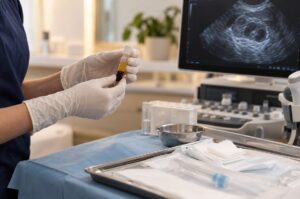
The appeal, compared with fragmentation, was obvious. No tissue removal. No laparoscopy. No general anaesthetic in the surgical sense. The plasma comes from the patient’s own blood, so there is nothing foreign involved. Delivery is by needle under transvaginal ultrasound guidance, using the same approach as a routine egg collection.
2017: the first intraovarian PRP procedure in Australia
Dr David Knight performed Australia’s first intraovarian PRP procedure in 2017.
Being first is easy to say and harder to sustain. What matters more than the date is what followed it. Dr Knight has since performed hundreds of these procedures and has refined the protocol continuously as the international research base has grown, adjusting who is offered treatment, how many treatments are recommended and how the procedure is sequenced against IVF.
That accumulated case experience is the practical difference between a clinic that lists ovarian rejuvenation as a service and one that has been performing it since 2017. It is also why patients travel to Demeter from interstate and from overseas.
Demeter subsequently withdrew ovarian fragmentation entirely in favour of the newer technique. That was a deliberate decision to stop offering a more invasive procedure once a less invasive one with better reported outcomes became available.
Dr David Knight, fertility pioneer
Dr Knight founded Demeter Fertility and has spent his career working at the edge of what reproductive medicine can offer, particularly for patients other clinics have run out of options for.
His work on ovarian rejuvenation has been covered widely in Australian media, including an appearance on Sunrise discussing the therapy, a discussion of ovarian rejuvenation and menopause, and international podcast interviews including Beat Infertility and Miracles Happen.
You can read more about his background and training on his practitioner profile.
Where the science stands now
The technique is no longer a single clinic’s experiment, but it is not settled practice either.
The most substantial evidence to date is a 2024 systematic review in the Journal of Ovarian Research covering 38 studies and 2,256 women with diminished ovarian reserve, premature ovarian failure or premature ovarian insufficiency, which found a statistically significant improvement in the main fertility parameters. Most of those studies measure changes in markers such as AMH and antral follicle count rather than live births, and large randomised controlled trials are still needed.
Research into other approaches, including stem cell therapy for ovarian tissue regeneration, continues internationally. Demeter does not offer stem cell treatment. We have also written about the broader set of pioneering techniques for ovarian related infertility.
What this history is useful for
The point of tracing this development is not to claim the problem is solved. It is to show that the options available to a woman with diminished ovarian reserve today are genuinely different from those available a decade ago, and that they changed because clinicians kept looking for something better than the answer they had.
If you want to understand the treatment itself rather than its history, read the complete guide to ovarian rejuvenation or the ovarian rejuvenation program page. If you would like Dr Knight’s view on your own situation, book an assessment.